
Above the American River canyons
Hydroseeding in Auburn, CA
At 1,227 feet with twice Sacramento's rainfall, Auburn slopes need serious erosion control.
- No charge to walk your lot, and every quote in writing
- Prep, seed, mulch and erosion control priced as separate lines
- A written watering schedule for the season you seed in
Erosion Control on Auburn's Steep Ground
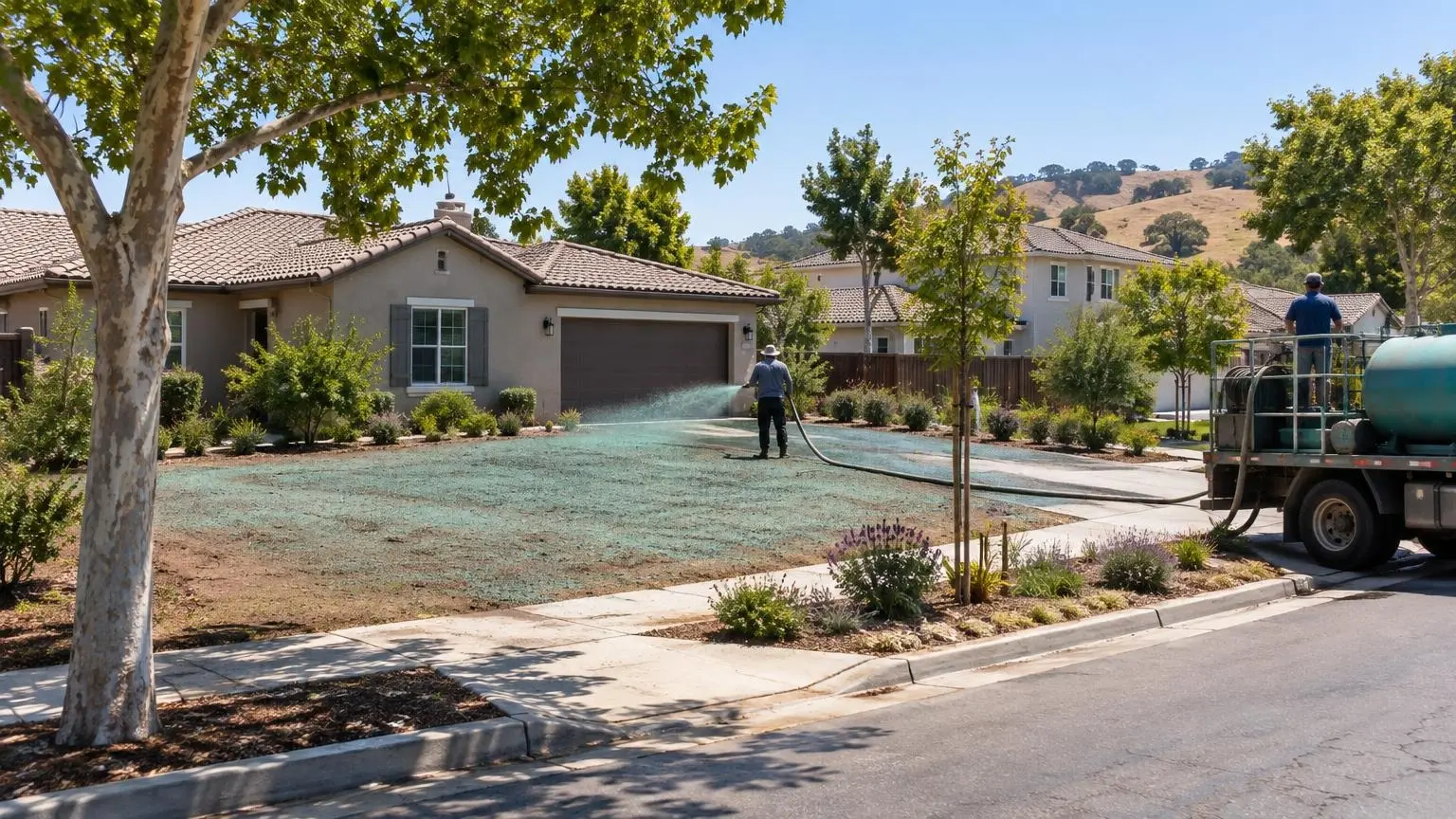
Hydroseeding in Auburn is erosion control first and lawn second. Auburn sits at 1,227 feet in the Sierra Nevada foothills, about 800 vertical feet above the confluence of the North and Middle Forks of the American River. Rolling foothills lie to the west and wilderness canyons to the east, and a lot of residential parcels are on real slopes.
Twice the rain of the valley
Auburn averages about 36.12 inches of precipitation a year, roughly double downtown Sacramento. The wettest year on record brought 64.87 inches, and 5.41 inches has fallen in a single day. On steep, freshly graded ground, that kind of rain moves soil fast. We plan Auburn slopes around blankets or bonded fiber matrix, wattles on the contour and a seed mix chosen to root deep, not a thin layer of mulch alone.
Shallow, rocky foothill soil
The USDA's Auburn soil series, mapped mainly in the Sierra Nevada foothills, forms in weathered amphibolite schist and is often only 25 to 50 centimeters deep to rock, on slopes from 2 to 75 percent. Its natural cover is annual grass, blue oak and interior live oak. On soils like that, a native or rangeland mix often establishes better than a lawn, and turf areas usually need imported topsoil.
Gold Rush ground
Gold was found on May 16, 1848, in the Auburn Ravine area, and placer mining moved up the ravine to the present town site. Old diggings, fill and uneven ground still show up on some lots, which makes fine grading and soil checks part of the job before seeding.
Cold snaps and heat
Auburn's record low is 5 degrees and its record high is 113, with about 63 days a year at or above 90. Snow is rare but not unknown. We avoid seeding into the coldest weeks and plan fall work so seed is up before the first frosts.
Typical Auburn work
- Slope stabilization with BFM or blankets
- Native and rangeland seeding on rocky ground
- Silt fence and fiber rolls for foothill builders
- Lawns with imported topsoil near the house
Get a free estimate or call (916) 249-7160.
Auburn Terrain, Soil and Rain
- Above the confluence. Auburn sits about 800 vertical feet above the confluence of the North and Middle Forks of the American River.
- Heavy rain. Average annual precipitation is 36.12 inches, with a 24-hour record of 5.41 inches on October 13, 1962.
- Shallow soil. The Auburn soil series forms in amphibolite schist and is often 25 to 50 cm deep to rock on slopes of 2 to 75 percent.
- Gold discovery. Claude Chana discovered gold in the Auburn Ravine area on May 16, 1848.
Auburn Questions
Will hydroseed hold on a steep Auburn slope?
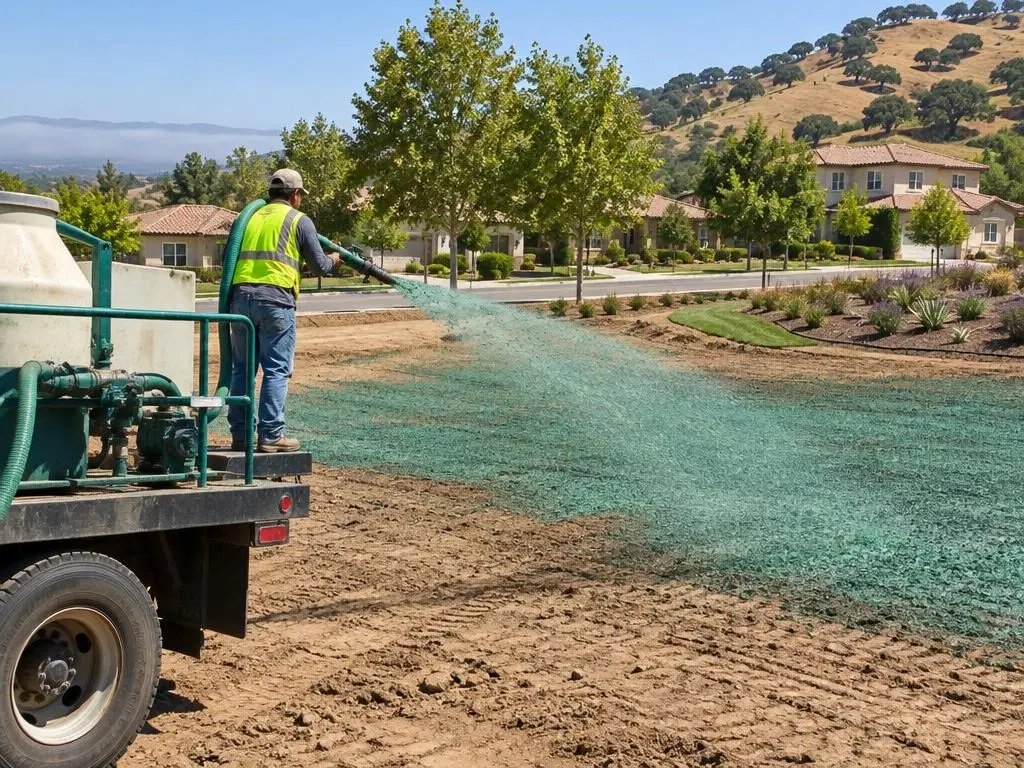
With the right product, yes. On steep foothill slopes we use a blanket or a coat of bonded fiber matrix, plus wattles on the contour, rather than standard mulch.
Can I get a lawn on rocky foothill soil?
Usually with imported topsoil. Many Auburn soils are shallow to rock, so a native or rangeland mix often makes more sense away from the house.
How does Auburn's rain change the plan?
With about 36 inches a year, slopes need to be covered before the first big storms. We schedule erosion control early in the fall.
Is winter seeding possible here?
It is risky. With frosts and the occasional snow, we prefer early fall or spring for seed, and use blankets for winter protection if work runs late.
Free Estimates in Auburn, CA
Free slope and lawn estimates in Auburn.
Hydroseeding Near Auburn
- Hydroseeding in Sacramento, CA
- Hydroseeding in Elk Grove, CA
- Hydroseeding in Roseville, CA
- Hydroseeding in Folsom, CA
- Hydroseeding in Rancho Cordova, CA
- Hydroseeding in Citrus Heights, CA
- Hydroseeding in Lincoln, CA
- Hydroseeding in Rocklin, CA
- Hydroseeding in Davis, CA
- Hydroseeding in West Sacramento, CA
- Hydroseeding in Woodland, CA
- Hydroseeding in El Dorado Hills, CA
- Hydroseeding in Granite Bay, CA
- Hydroseeding in Fair Oaks, CA
- Hydroseeding in Carmichael, CA
- Hydroseeding in Orangevale, CA
- Hydroseeding in Loomis, CA
- Hydroseeding in Cameron Park, CA
- Hydroseeding in Antelope, CA
- Hydroseeding in Rio Linda, CA
- Hydroseeding in Wilton, CA
- Hydroseeding in Rancho Murieta, CA