
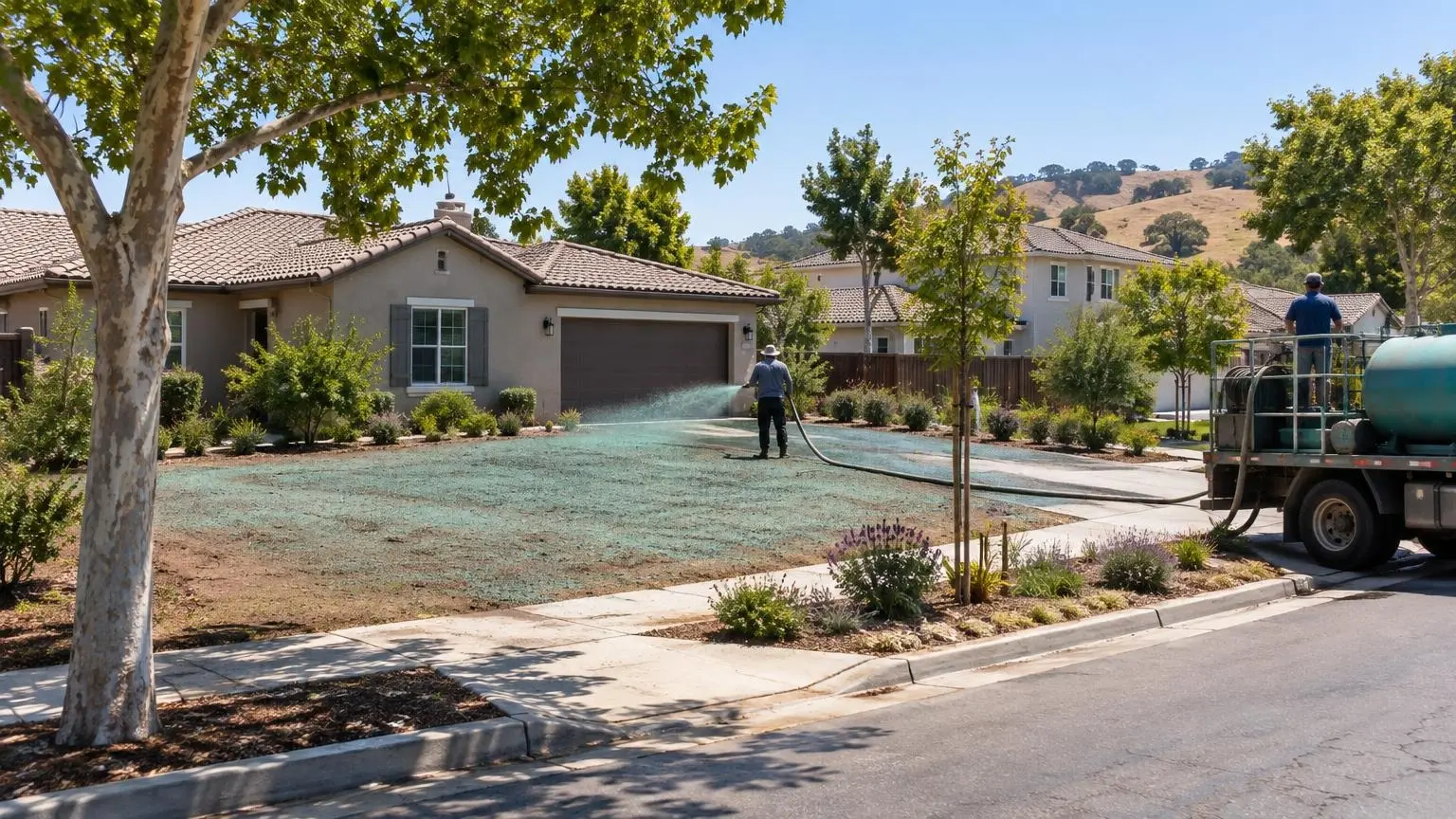
Before the first storm
Erosion Control & Hydromulch in Sacramento, CA
Slopes, banks and swales covered and seeded so winter rain soaks in instead of carrying soil away.
- No charge to walk your lot, and every quote in writing
- Prep, seed, mulch and erosion control priced as separate lines
- A written watering schedule for the season you seed in
Holding Soil Through the Wet Months
Erosion control & hydromulch work in Sacramento is about the five months when it rains. From November through April the region gets nearly all of its yearly precipitation, and bare slopes, berms, ditch banks and swales that sat harmlessly all summer start to rill and slump with the first heavy storm. Our erosion control services, the core of what erosion control contractors do, cover that ground with sprayed mulch, bonded fiber matrix or rolled blankets, seeded with grass or native mixes that root in over the winter and hold the soil for good.
Where erosion shows up here
On the valley floor most lots are flat, so erosion problems tend to be smaller and local: the slope from a raised pad down to a backyard, the bank of a drainage swale, a berm along a fence line, a freshly trenched utility line. Toward the foothills in El Dorado Hills, Folsom, Cameron Park and Auburn, real slopes become the norm and the stakes rise. Bare soil on any of them moves the same way. Raindrops loosen the surface, sheet flow carries the fines, and small rills cut into gullies if nothing slows the water down. Soil that leaves your slope ends up in the street, the storm drain and eventually the river.
Matching the cover to the slope
The City of Sacramento's sediment control manual draws a useful line. Standard hydromulch, which is wood or paper fiber with a tackifier, is generally not recommended on slopes steeper than about 4 to 1. Bonded fiber matrix, a heavier fiber held together by a binder that dries into a continuous mat, can be used up to about 2 to 1. Steeper than that, or in channels where water concentrates, we turn to rolled erosion control blankets: straw blankets for short-term cover, straw and coconut for longer protection, and coir where flow is faster or the slope has to hold for more than a season. Blankets are stapled in place over seed, overlapping like shingles, with the top edge buried in a trench so water cannot get underneath.
Hydromulch on gentler ground
For most backyard berms and shallow banks, a heavy coat of hydromulch with seed is enough. It goes on quickly, covers irregular ground that blankets would bridge over, and needs no staples to pull out later. The manual asks for mulch to follow seed within a day when the two go on as separate passes, and for both to go down at least 24 hours before forecast rain so the binder can set. We follow that schedule and keep an eye on the forecast all fall.
Seed mixes for slopes
A slope that will be mowed can be seeded with the same fescue or Bermudagrass as the rest of the lawn, though mowing a slope is not much fun. A slope that will not be mowed usually does better with an erosion mix: annual cover for fast protection plus perennial or native grasses for long-term roots. On open ground that will not get summer water, native grass and wildflower seeding makes sense, since those mixes can be sown in fall and carried by winter rain, then go dormant in the dry season the way the surrounding hills do.
Soil and water on Sacramento slopes
Much of the valley's soil is loam over dense clay and hardpan, which the USDA describes as very slowly permeable with medium to very high runoff. On a slope that means more water runs off and less soaks in, so the cover has to stand up to sheet flow. Where a swale or downspout concentrates water onto a seeded area, we look at whether it needs a rock-lined outlet, a wider swale or a blanket rated for channel flow instead of just more mulch.
Homeowner slopes versus construction slopes
On a home, erosion control is usually about one problem area: a bank behind the fence, a slope that drops to the side yard, or soil washing out of a planting bed onto the patio. On construction ground the scale is larger and the stormwater plan spells out what goes where. Either way, the materials are the same, and so is the rule of thumb: the steeper the ground and the more water it carries, the heavier the cover needs to be. We size the job to the slope instead of selling the most expensive product on every bank.
Checking slopes after storms
The first big storm of the season is the real test. We look at slopes and swales after it, re-anchor any blanket that lifted, fill rills that started before vegetation took hold, and reseed spots that washed.
Timing and permits
The best time to seed and cover slopes is early fall, ahead of the rains, and the city manual names mid-October through mid-April as the optimum planting period. Some foothill counties set their own stabilization deadlines for bare ground going into winter, and we plan around them. Larger grading jobs may also need a permit and a stormwater plan, and we install what those documents call for. Call (916) 249-7160 to have us look at a slope.
Slope and Erosion Control Options
We pick the lightest cover that will hold the grade you have.
Hydromulch with seed
Wood fiber mulch and tackifier for gentle slopes, berms and open ground.
Bonded fiber matrix (BFM)
A continuous sprayed mat for slopes up to about 2 to 1.
Straw erosion control blankets
Short-term rolled cover stapled over seed on steeper ground.
Straw-coconut and coir blankets
Longer-lasting blankets for steep slopes and swale bottoms.
Swale and ditch lining
Seed and blanket or mulch matched to how much water the channel carries.
Native grass and wildflower seeding
Fall-sown mixes for unirrigated slopes and open space.

Typical Erosion Control Costs
| Item | Typical range (source) |
|---|---|
| Sprayed wood-fiber mulch per 1,000 square feet (2025 DOT erosion pay items) | $98 |
| Straw mulch spread dry by hand, per 1,000 square feet (same list) | $170 |
| 70/30 straw-and-coconut blanket, every 1,000 square feet (same list) | $468 |
| Coir blanket installed, every 1,000 square feet (same list) | $532 |
| Extra for steep ground on a home hydroseeding job (HomeGuide) | $0.05 to $0.10 added per square foot |
| Bonded fiber matrix | Quoted once we see the slope |
The DOT figures are 2025 installed public-works prices, not Sacramento quotes, and slope length, access and anchoring move the number. Published averages; we quote each property in writing and stick to it.
Stabilizing a Slope
1. Look at the water
Where it comes from, where it goes and how steep the ground is.
2. Choose the cover
Hydromulch, BFM or blanket, with a seed mix for the use.
3. Prepare the surface
Rills filled, loose material removed, surface roughened across the slope.
4. Seed and cover
Seed applied, then mulch, BFM or blankets anchored and trenched in.
5. Check after storms
We look at problem spots after the first big rains.
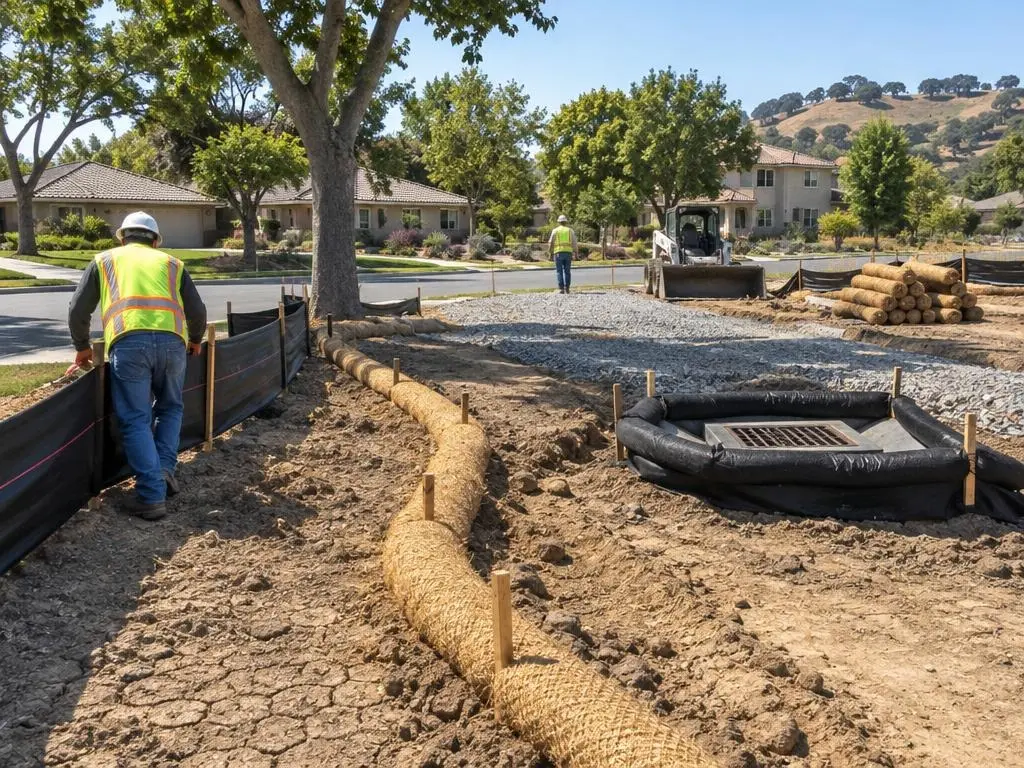
Why Choose Us for Erosion Control & Hydromulch
Slope-matched materials
We follow the 4-to-1 and 2-to-1 guidance in the city manual instead of one product for everything.
Ahead of the rain
Covers go on before forecast storms, with time for binders to set.
Water first
We fix where water concentrates, not just the bare spot it leaves.
Erosion Control & Hydromulch Questions
Hydromulch or erosion blanket for my slope?
On grades gentler than about 4 to 1, hydromulch with seed usually holds. Steeper ground, up to about 2 to 1, calls for bonded fiber matrix or blankets, and channels or very steep banks usually need blankets.
When should a slope be seeded in Sacramento?
Early fall, so the seed and cover are in place before the November to April rains. Seeding in late spring leaves a slope relying entirely on irrigation through summer.
Will someone have to pull the blankets up later?
No. Straw and coir fibers rot away in place while new growth comes through them. Some products are made with plastic netting, so where wildlife or a mower could get caught in it we pick netting that biodegrades.
Will native grass stay green all summer?
No. Most native and dryland mixes go golden in the dry months like the surrounding hills, then green up with the fall rains. Their roots keep holding soil while they are dormant.
What is bonded fiber matrix?
A hydraulically sprayed mulch mixed with a binder; once it cures it forms one unbroken, porous layer. It grips steeper ground better than standard hydromulch, and seedlings still push up through it.
Erosion Control & Hydromulch Service Areas
- Hydroseeding in Sacramento, CA
- Hydroseeding in Elk Grove, CA
- Hydroseeding in Roseville, CA
- Hydroseeding in Folsom, CA
- Hydroseeding in Rancho Cordova, CA
- Hydroseeding in Citrus Heights, CA
- Hydroseeding in Lincoln, CA
- Hydroseeding in Rocklin, CA
- Hydroseeding in Davis, CA
- Hydroseeding in West Sacramento, CA
- Hydroseeding in Woodland, CA
- Hydroseeding in El Dorado Hills, CA
- Hydroseeding in Granite Bay, CA
- Hydroseeding in Fair Oaks, CA
- Hydroseeding in Carmichael, CA
- Hydroseeding in Orangevale, CA
- Hydroseeding in Loomis, CA
- Hydroseeding in Auburn, CA
- Hydroseeding in Cameron Park, CA
- Hydroseeding in Antelope, CA
- Hydroseeding in Rio Linda, CA
- Hydroseeding in Wilton, CA
- Hydroseeding in Rancho Murieta, CA
Get an Erosion Control & Hydromulch Estimate
Free slope and erosion control assessments before the rainy season.