
Valley lawns, foothill slopes
Hydroseeding in Sacramento, CA
Seed, mulch and erosion control planned around hardpan soil, a short rainy season and a very long summer.
- No charge to walk your lot, and every quote in writing
- Prep, seed, mulch and erosion control priced as separate lines
- A written watering schedule for the season you seed in
Getting Grass to Take in the Sacramento Valley
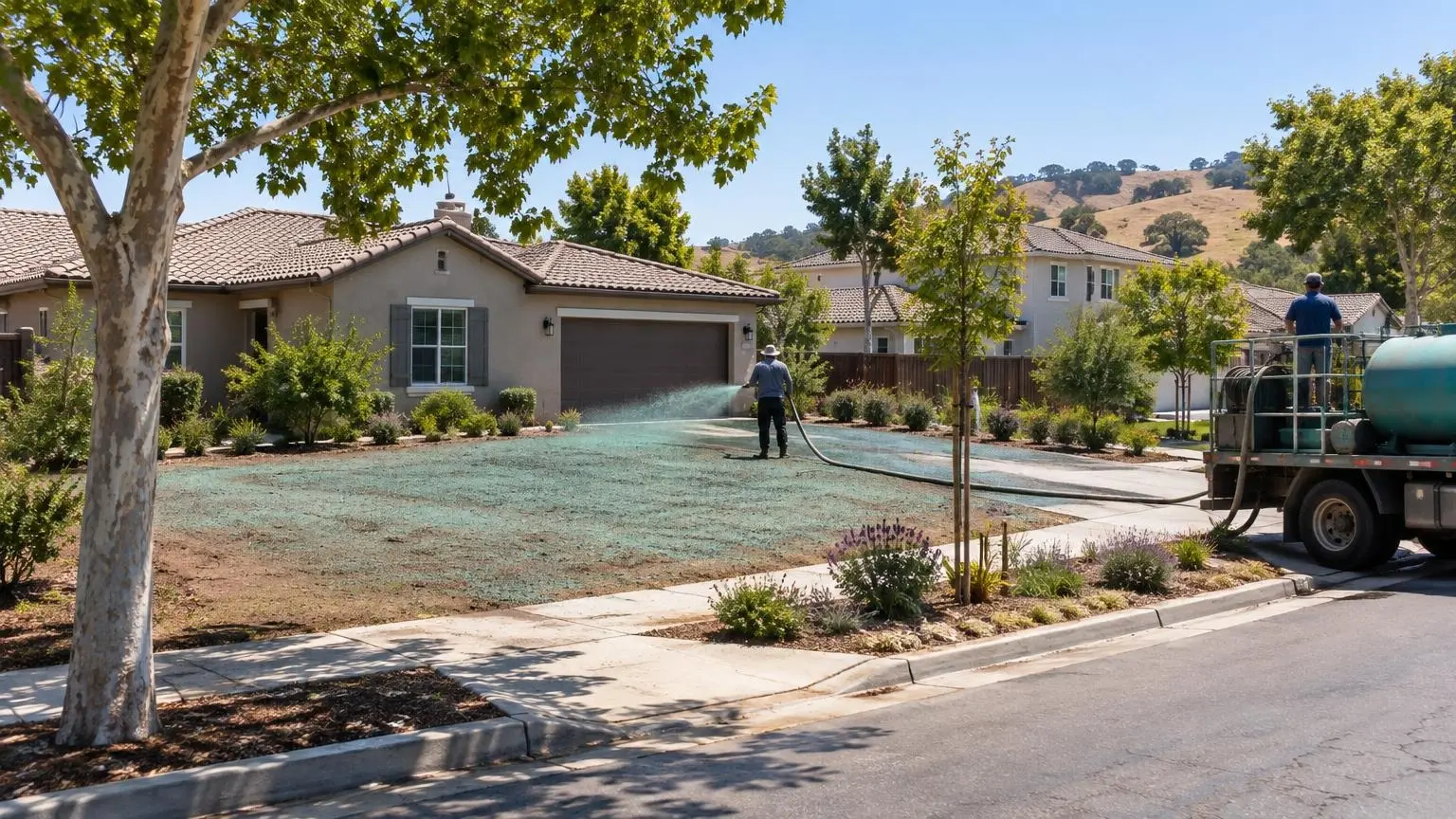
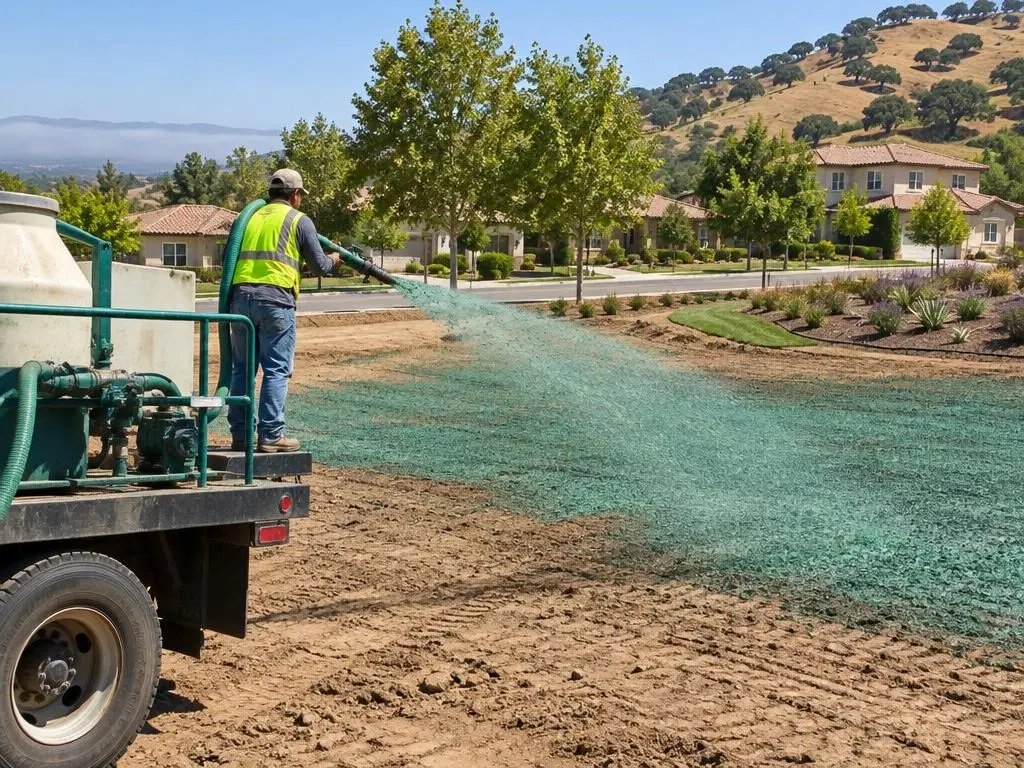
Hydroseeding in Sacramento is a contest with two clocks: a rainy season that lasts about five months and a summer that seems to last forever. We spray a slurry of water, grass seed, fertilizer, tackifier and wood fiber mulch onto prepared soil, with a green tint so you can see exactly where it landed. Hydroseeding Sacramento is a hydroseeding company that handles new lawns, builder lots, slopes and drainage swales, silt fence and sediment control, grading and topsoil, and overseeding of worn lawns across the city and the valley and foothill towns around it. Most jobs start with a site visit and end with a written estimate, because no two lots here drain or dry out the same way.
What the weather actually does to a seedbed
Sacramento has a hot-summer Mediterranean climate. Nearly all of the city's roughly 18 inches of yearly rain falls between November and April, and measurable rain in July is almost unheard of. On average the airport logs 76 days each year that reach 90 degrees and 14 that reach 100 or more, and July sunshine runs near 98 percent of the possible total, among the sunniest months recorded anywhere. That is hard on a young lawn. The evening delta breeze coming up from the bay cools nights off, but a seedbed in full summer sun can go from damp to dry between breakfast and lunch. At the other end of the year, December and January bring tule fog that can hang on for days with highs below 50 degrees, and the city sees only about 15 freezing nights a year. Seed sown in deep winter rarely dies of cold; it simply sits and waits for warmth. Rainfall also swings wildly from year to year, from under 6 inches in 2013 to over 33 inches in 1983, so we plan irrigation as if the rain will not come.
The ground under a valley lawn
Much of the eastern side of the Sacramento Valley is mapped as San Joaquin series soil, a brown loam on old river terraces that the USDA describes as having very slow permeability and medium to very high runoff. The surface loam is easy to work. A foot or two down, the clay content jumps sharply, and below that sits a cemented hardpan, or duripan, usually somewhere between 20 and 40 inches deep. Water that soaks in reaches a layer it cannot get through, so it either pools or moves sideways. The USDA description also notes that the upper subsoil stays dry from June into November. For seeding, that means two things. In summer the top inch dries fast and has to be watered in short, frequent cycles. In winter, low spots on a hardpan lot stay soggy, and seed sitting in water rots. We look for both on the site visit and grade so water leaves the lawn instead of collecting in it.
Sod, hydroseed or dry seed
All three can make a good Sacramento lawn. They differ in price, speed and how much attention the first month takes. Sod gives you grass the day it goes down and takes foot traffic early, but national cost guides put it at several times the price of hydro seeding, and every seam has to root into the native soil before the first heat wave or it browns at the edges. Broadcast dry seed is the cheapest material, though on bare ground the seed sits exposed to birds, wind and sun, and it is slow to come up. Hydroseed sits between them. The fiber mulch holds the seed against the soil and keeps it damp, and the tackifier keeps the mix from blowing or washing off. Extension writers say hydroseeded grass usually emerges within 5 to 7 days when conditions are good, compared with two to three weeks for dry seed. For a big backyard, a sloped side yard or a new-construction lot, a hydroseed lawn is usually the best value. For a small front strip that has to look finished next week, sod may be the better buy, and we will tell you that.
Picking the seeding window
The right month depends on the grass. The UC Master Gardeners of Sacramento County describe two families. Green-in-winter grasses such as fescue and bluegrass stay green through the cool season but are harder to keep alive through a Mediterranean summer. Brown-in-winter grasses such as Bermudagrass go dormant and tan in winter but handle heat and drought on deep roots. For fescue blends, which most homeowners here still choose, we prefer early fall, roughly late September through October, when the soil is still warm, nights are cooling and the first storms are close. The City of Sacramento's sediment control manual names mid-October through mid-April as the best stretch for permanent planting on disturbed ground. Bermudagrass needs warm soil, so it goes in from late spring into early summer. Spring fescue seeding in March or April can work, but the lawn meets its first 100-degree week with short roots, so irrigation has to be right. Summer seeding is possible when a deadline will not move, with the timer set for several brief cycles a day.
Runoff, bare dirt and the local rules
Sacramento ranks behind only New Orleans among American cities for flood susceptibility, and local stormwater rules treat exposed soil seriously. Inside city limits, a grading permit kicks in once a project moves 50 cubic yards or cuts or fills more than 2 feet. In unincorporated Sacramento County the threshold is 350 cubic yards or an acre of clearing. Any project that clears or grades an acre or more, or belongs to a larger development that will, needs coverage under the State Water Resources Control Board's Construction General Permit. That is why our crews carry silt fence, fiber rolls and inlet protection, and why the city manual's advice to spray at least a day ahead of forecast rain sets our winter schedule. On grades steeper than about 4 to 1, ordinary hydromulch gives way to bonded fiber matrix or erosion control blankets.
Shade, old lawns and the City of Trees
Sacramento has called itself the City of Trees since the 1800s, and London plane trees make up much of its canopy today. Lawns under that shade thin out over the years and fill with invaders; the Master Gardeners list crabgrass, Bermudagrass, dallisgrass, nutsedge, oxalis and dandelion as the usual suspects. Many of those yards are better served by overseeding with a shade-tolerant blend, or by a patch hydroseed after the weeds are dealt with, than by starting over. We check sun hours, sprinkler coverage and weed pressure before recommending either.
How a job runs
We walk the property, measure, check the grade and the sprinklers, and send a written estimate that lists prep, seed, mulch and any erosion control on their own lines. On seeding day the crew fine-grades and loosens the surface, adds topsoil or amendments where the estimate calls for them, sprays, and leaves a watering schedule written for that season. Get a free estimate or phone (916) 249-7160 and we will put a walk-through on the calendar.
Our Services
Hydroseeding services plus five related seeding, soil and slope jobs for Sacramento-area homeowners, builders and property managers.
Residential Lawn Hydroseeding
New hydroseed lawns for homes, from bare tract lots to old yards being started over.
Learn more →Builder & Commercial Hydroseeding
Seeding for builders, developers and property managers: lots, pads, basins, roadsides and large open ground.
Learn more →Erosion Control & Hydromulch
Slopes, swales and banks held in place with hydromulch, erosion control blankets or bonded fiber matrix.
Learn more →Silt Fence & Sediment Control
Silt fence installation, fiber rolls, inlet protection and stabilized entrances for job sites.
Learn more →Yard Grading & Soil Prep
Yard grading, topsoil, fine grading and dirt work that set up a lawn to drain and grow.
Learn more →Lawn Overseeding & Repair
Overseeding, patch hydroseeding and renovation for thin, weedy or worn Sacramento lawns.
Learn more →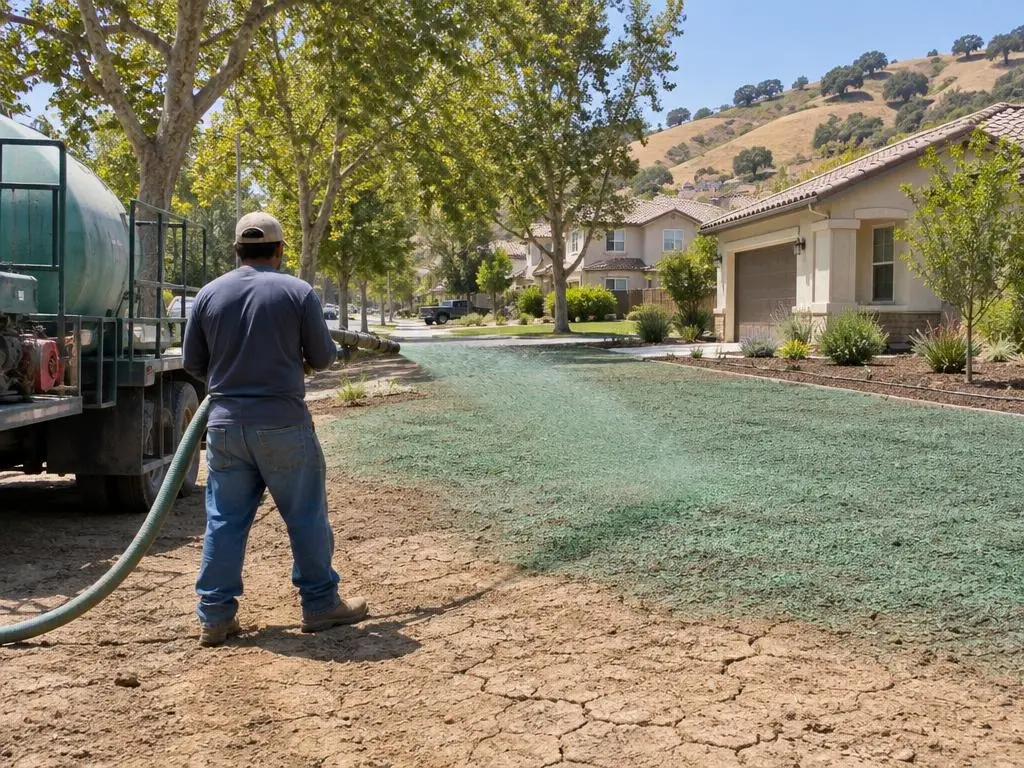
Why Homeowners Call Hydroseeding Sacramento
Timed to the rain
We plan seeding dates around the November to April wet season and spray ahead of storms so the mulch can set.
Hardpan-aware prep
We check how water moves on your lot and grade low spots out before seed goes down.
The right mix for the yard
Fescue blends, Bermudagrass or erosion mixes, chosen for sun, shade, traffic and slope rather than one tank for every job.
Line-item estimates
Grading, topsoil, seed, mulch and erosion control each get their own price line, so nothing hides inside a lump sum.
Valley Floor to Foothills
We work throughout Sacramento and in Elk Grove, Rancho Cordova, Citrus Heights, Antelope, Rio Linda, Carmichael, Fair Oaks, Orangevale and Wilton in Sacramento County; Roseville, Rocklin, Lincoln, Loomis, Granite Bay and Auburn in Placer County; Folsom and Rancho Murieta to the east; El Dorado Hills and Cameron Park in El Dorado County; and Davis, Woodland and West Sacramento across the river in Yolo County. The ground changes a lot over that distance. Low, flat lots near the rivers and bypasses fight standing water, hardpan suburbs north of the city drain slowly, and the granite and red clay of the foothills bring real slopes and county deadlines for winterizing bare soil. The town pages below go into the local soil, slope and drainage details.
- Hydroseeding in Sacramento, CA
- Hydroseeding in Elk Grove, CA
- Hydroseeding in Roseville, CA
- Hydroseeding in Folsom, CA
- Hydroseeding in Rancho Cordova, CA
- Hydroseeding in Citrus Heights, CA
- Hydroseeding in Lincoln, CA
- Hydroseeding in Rocklin, CA
- Hydroseeding in Davis, CA
- Hydroseeding in West Sacramento, CA
- Hydroseeding in Woodland, CA
- Hydroseeding in El Dorado Hills, CA
- Hydroseeding in Granite Bay, CA
- Hydroseeding in Fair Oaks, CA
- Hydroseeding in Carmichael, CA
- Hydroseeding in Orangevale, CA
- Hydroseeding in Loomis, CA
- Hydroseeding in Auburn, CA
- Hydroseeding in Cameron Park, CA
- Hydroseeding in Antelope, CA
- Hydroseeding in Rio Linda, CA
- Hydroseeding in Wilton, CA
- Hydroseeding in Rancho Murieta, CA
Common Questions
What is the best month to hydroseed in Sacramento?
For cool-season fescue lawns, late September through October is usually best: the soil is warm, nights are cooler and the rains are close. Bermudagrass goes in from late spring into early summer, once the soil has warmed. Spring and summer fescue seeding works too, but it takes more careful watering.
How much does hydroseeding cost in Sacramento?
Depending on which national cost guide you read, residential hydroseeding runs between $0.07 and $0.35 a square foot, and HomeGuide puts a lawn of roughly 5,000 square feet at $1,000 to $1,750. Many hydroseeding companies also set a minimum job charge. Grading, topsoil and slope work come on top, and the number written down after we walk your lot is the one we bill.
How long until I can walk on or mow a hydroseeded lawn?
In warm weather, sprouts usually show in about a week. Plan the first mow somewhere around week four to six, when the blades reach roughly 4 inches. Keep foot traffic, pets and kids off it until after the second or third mowing.
How often do I water new hydroseed in Sacramento heat?
In summer, plan on several short cycles a day for the first two to three weeks so the mulch never dries out, then fewer, longer waterings as roots go deeper. In fall the weather does some of the work, and once the rains start you may only need to water between storms.
Can you hydroseed a drought-tolerant lawn?
Yes. Warm-season Bermudagrass handles heat and dry spells far better than fescue, though it goes tan in winter. On slopes and open ground that will not be mowed, we can spray erosion and native grass mixes that need little or no summer water once established.
Will hydroseed wash away if it rains?
A light rain after the mulch has had a day to set usually helps. A heavy storm on fresh slurry, especially on a slope, can move it, which is why we try to spray at least 24 hours before forecast rain and use bonded fiber matrix or blankets on steeper ground.
Is hydroseed or sod better for a Sacramento backyard?
For most backyards over a few thousand square feet, hydroseed costs far less and roots straight into your soil. Sod makes sense when you need a finished lawn right away or the area is small and high-traffic. Both need good grading and irrigation to survive July.
Book a Free Site Visit Before the Rains
Tell us about the lot and we will come measure, check the grade and send a written estimate.