
Where two rivers meet
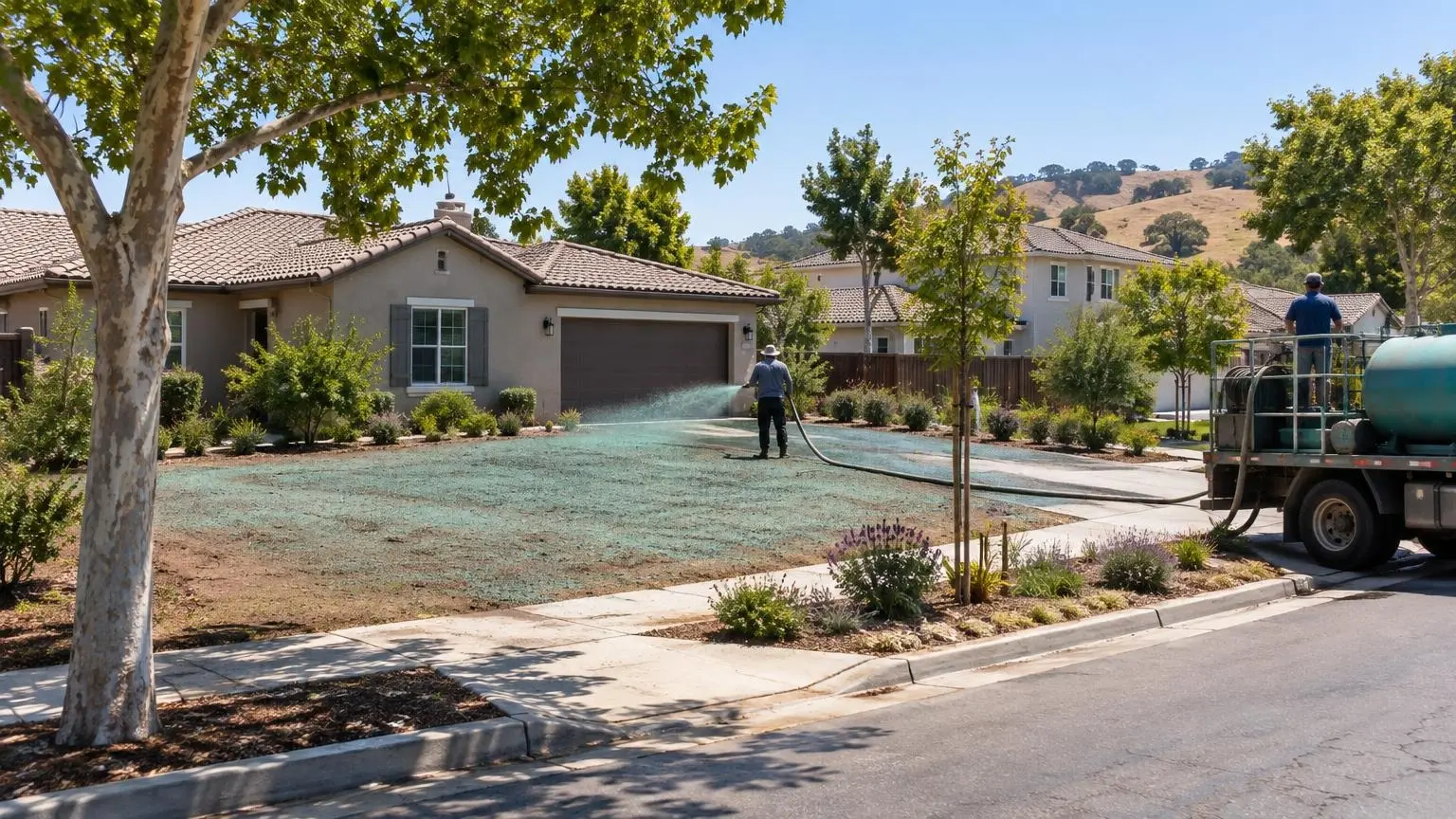
Hydroseeding in Sacramento, CA
Flat, low ground at the American and Sacramento confluence, with dry summers and a short wet season that decides when seed goes down.
- No charge to walk your lot, and every quote in writing
- Prep, seed, mulch and erosion control priced as separate lines
- A written watering schedule for the season you seed in
Seeding a City Built on River Ground
Hydroseeding in Sacramento starts with the calendar. The city sits at about 26 feet of elevation where the American River meets the Sacramento River, and it has a hot-summer Mediterranean climate: long, dry summers and a short, mild wet season, with most of the roughly 18 inches of yearly rain falling between November and April. A hydroseed lawn put down in that window gets help from the sky. One sprayed in July depends on the irrigation system from the first hour.
The planting window the city itself names
The City of Sacramento's sediment control manual calls October 15 through April 15 the optimum time for permanent planting. That lines up with what we see on residential lots: fall seeding lets cool-season grass root in before the winter rains, while summer seeding needs a timer set for short, frequent cycles because the city averages 76 days a year at or above 90 degrees.
Two-step hydromulch and the 24-hour rule
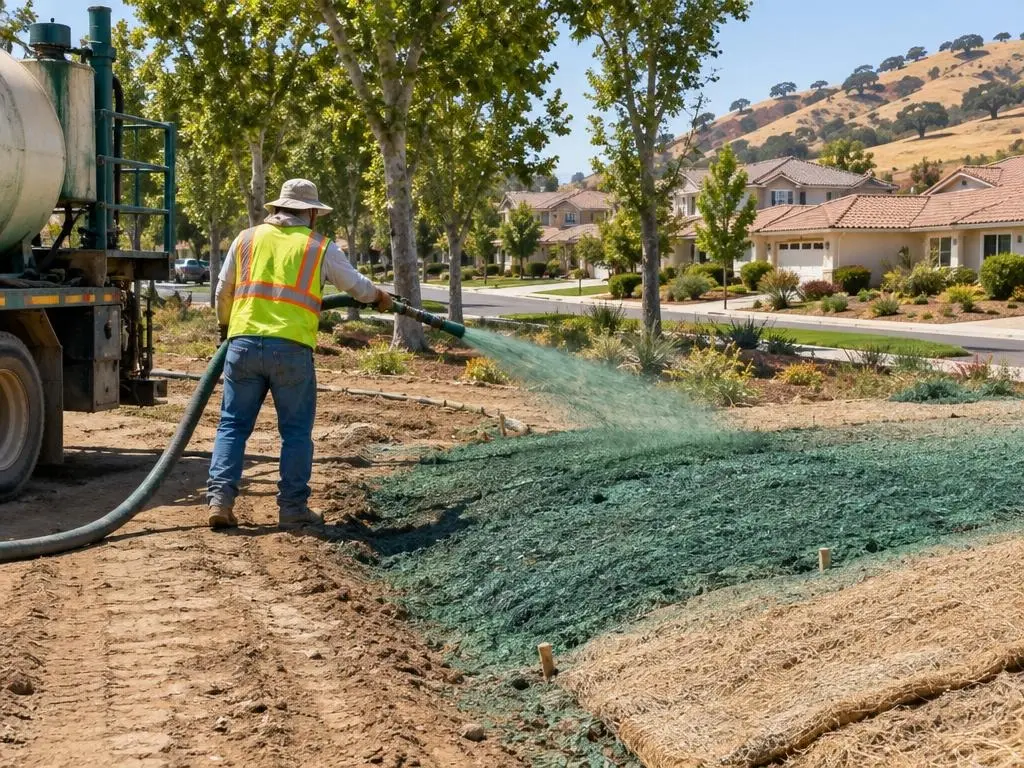
The same manual asks for hydroseed and hydromulch to go down at least 24 hours before forecast rain, and for mulch to follow seed within 24 hours when it is applied as two passes. It also says standard hydromulch is generally not for slopes steeper than about 4:1, while bonded fiber matrix can hold up to 2:1. On a backyard berm or a drainage swale in Sacramento, that is often the deciding line between plain hydromulch and BFM.
Flood history and low lots
Sacramento has a long flood record, from 1850 and 1862 to 1980, and is considered the second most flood-susceptible city in the country after New Orleans. Much of Natomas, which the city annexed in large pieces from the 1970s to the 1990s, sits on the historic Sacramento River floodplain. On flat, low lots like these, we grade so water moves off the yard toward the street or a swale before we spray, because seed sitting in a puddle for a week rarely makes it.
When a grading permit comes into play
Inside city limits, the manual says a grading permit is needed once graded material reaches 50 cubic yards or a cut or fill goes deeper than 2 feet. Most lawn regrades stay under that. Larger dirt work, new drainage trenching or a builder pad can cross it, and then silt fence, fiber rolls, inlet protection and a stabilized entrance become part of the job.
A note on trees
Sacramento calls itself the City of Trees. Under dense street canopy, we switch to a shade-tolerant mix. Get a free estimate or call (916) 249-7160.
Sacramento Conditions That Shape a Seeding Plan
- Rain season. Average yearly precipitation is 18.14 inches, and most of it falls from November to April.
- Summer heat. The city averages 76 days at or above 90 degrees F and 14 days at or above 100 degrees F.
- Planting window. The city sediment control manual lists October 15 through April 15 as the optimum time for permanent planting.
- Slope limit for mulch. The manual says hydromulch is generally not for slopes steeper than 4:1 or 5:1, while bonded fiber matrix can go up to 2:1.
- Flood plain. Natomas was historically farmland on the floodplain of the Sacramento River and is subject to flooding.
Sacramento Questions
Is fall or spring better for a hydroseeded lawn in Sacramento?
Fall is usually easier. The city's own manual names October 15 to April 15 as the best permanent planting period, and fall seed gets the winter rain behind it. Spring works too, but the lawn heads into 90-degree weather young.
How soon before a storm can you spray?
The city manual asks for hydroseed to go down at least 24 hours before forecast rain so the mulch can set. We watch the forecast and move the date if a storm is due sooner.
My Natomas yard holds water after rain. Can you still seed it?
Yes, but we fix the grade first. A low yard on old floodplain ground needs a path for water to leave before seed goes down, or the low spots stay bare.
Do I need a city grading permit to regrade my yard?
Only if you move 50 cubic yards or more of soil or cut or fill more than 2 feet, per the city manual. Most lawn regrades stay below that, and we will tell you if yours does not.
Free Estimates in Sacramento, CA
Free written estimates anywhere in Sacramento.
Hydroseeding Near Sacramento
- Hydroseeding in Elk Grove, CA
- Hydroseeding in Roseville, CA
- Hydroseeding in Folsom, CA
- Hydroseeding in Rancho Cordova, CA
- Hydroseeding in Citrus Heights, CA
- Hydroseeding in Lincoln, CA
- Hydroseeding in Rocklin, CA
- Hydroseeding in Davis, CA
- Hydroseeding in West Sacramento, CA
- Hydroseeding in Woodland, CA
- Hydroseeding in El Dorado Hills, CA
- Hydroseeding in Granite Bay, CA
- Hydroseeding in Fair Oaks, CA
- Hydroseeding in Carmichael, CA
- Hydroseeding in Orangevale, CA
- Hydroseeding in Loomis, CA
- Hydroseeding in Auburn, CA
- Hydroseeding in Cameron Park, CA
- Hydroseeding in Antelope, CA
- Hydroseeding in Rio Linda, CA
- Hydroseeding in Wilton, CA
- Hydroseeding in Rancho Murieta, CA